Aspects in Western Astrology
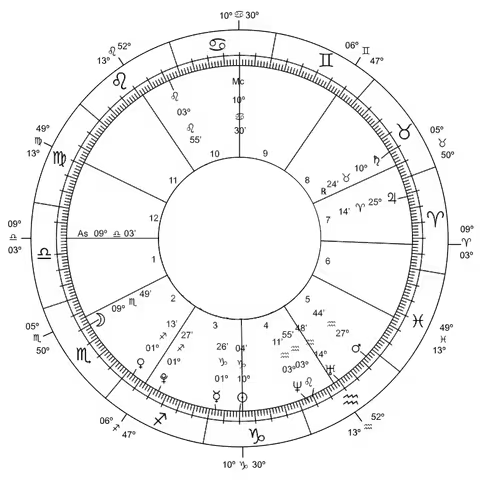
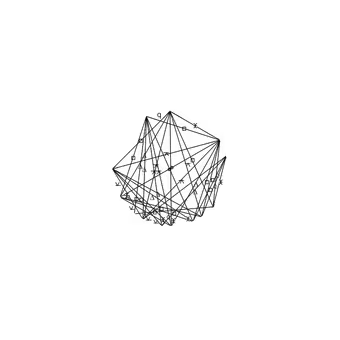
Aspects are the angular relationships between planets in a birth chart. They reveal how different parts of your personality communicate, cooperate, or clash with each other. A chart without aspects would be a collection of isolated energies; aspects are the wiring that connects them into a living, dynamic whole. Understanding your aspects is essential for seeing the full picture of who you are.
Major Aspects
Conjunction
0° · Orb: 8–10°
What is a conjunction in astrology? A conjunction happens when two planets sit at the same degree of the zodiac, blending their energies into one concentrated force. It is the strongest aspect in a birth chart because the planets involved lose their separate boundaries and work as a unit. Whether the result is positive or difficult depends entirely on which planets are paired. Two benefics together produce fortunate outcomes; two malefics together amplify problems.
Sextile
60° · Orb: 4–6°
What is a sextile in astrology? A sextile forms when two planets are 60 degrees apart, usually linking signs of compatible elements (fire with air, earth with water). This aspect opens a channel of opportunity and easy communication between the planets. Unlike a trine, which flows on autopilot, the sextile asks for a small push of effort to activate. Once you engage it, the results tend to be creative and productive.
Square
90° · Orb: 6–8°
What is a square in astrology? A square forms when two planets are 90 degrees apart, creating a tense, friction-heavy relationship between their energies. Squares connect signs that share the same modality (cardinal, fixed, or mutable) but clash in element, producing an internal conflict that pushes you to act. This is the aspect of challenge and growth. The pressure is real, but it builds strength.
Trine
120° · Orb: 6–8°
What is a trine in astrology? A trine forms when two planets are 120 degrees apart, connecting signs of the same element. It is the most harmonious major aspect, creating an effortless energy flow between the planets. Trines point to innate gifts and natural talents. The shared element determines the flavour: fire trines bring creative confidence, earth trines bring practical skill, air trines bring mental fluency, and water trines bring emotional depth.
Opposition
180° · Orb: 8–10°
What is an opposition in astrology? An opposition forms when two planets are 180 degrees apart, sitting on opposite sides of the chart. It creates a see-saw dynamic where the two energies pull in opposite directions, often showing up through relationships and external events. Oppositions link complementary signs (Aries-Libra, Taurus-Scorpio, etc.), and the challenge is to find a balance point between two needs that both feel valid.
Minor Aspects
Quincunx
150° · Orb: 2–3°
What is a quincunx in astrology? A quincunx (also called an inconjunct) forms when two planets are 150 degrees apart, linking signs that share no element, modality, or polarity. The result is an awkward, puzzling connection. The two planets simply do not speak the same language. This is the aspect of adjustment: it asks for constant fine-tuning to reconcile two fundamentally different ways of operating.
Semi-Sextile
30° · Orb: 1–2°
What is a semi-sextile in astrology? A semi-sextile forms when two planets are 30 degrees apart, connecting adjacent signs. Because neighbouring signs always differ in element, modality, and often polarity, this aspect creates a mild, low-level friction between the planets. It is the aspect of quiet, incremental growth: small adjustments that add up to real change over time.
Quick Reference
| Aspect | Symbol | Angle | Orb | Type | Quality |
|---|---|---|---|---|---|
| Conjunction | ☌ | 0° | 8–10° | Major | Neutral |
| Sextile | ⚹ | 60° | 4–6° | Major | Harmonious |
| Square | □ | 90° | 6–8° | Major | Dynamic |
| Trine | △ | 120° | 6–8° | Major | Harmonious |
| Opposition | ☍ | 180° | 8–10° | Major | Dynamic |
| Quincunx | ⚻ | 150° | 2–3° | Minor | Dynamic |
| Semi-Sextile | ⚺ | 30° | 1–2° | Minor | Neutral |
How Aspects Work in a Birth Chart
Every aspect has an orb of influence — a range of degrees within which the aspect is considered active. Tighter orbs produce stronger, more noticeable effects, while wider orbs create a subtler background influence. The five major aspects (conjunction, sextile, square, trine, opposition) form the backbone of chart interpretation, while minor aspects add nuance and detail.
Aspects can be applying (the faster planet is moving toward exact) or separating (the faster planet is moving away). Applying aspects represent energies that are building toward a peak, while separating aspects describe experiences that are already in the process of resolving. Some astrologers give greater weight to applying aspects, viewing them as more active and potent.
When multiple aspects connect three or more planets, they form aspect patterns such as the Grand Trine, T-Square, Grand Cross, and Yod. These configurations create complex dynamics that define major themes in a person's life and are often the most revealing features of a birth chart.
Explore More Western Astrology
Aspects connect the planets in your chart, which express through the zodiac signs and houses. Together, these four components create the complete picture of your astrological blueprint.
Discover Your Aspect Patterns
Curious about the aspects in your birth chart? Our AI astrologer can identify your major aspect patterns and explain how they shape your personality and life path.
Analyse Your Birth Chart