
Planets in Western Astrology
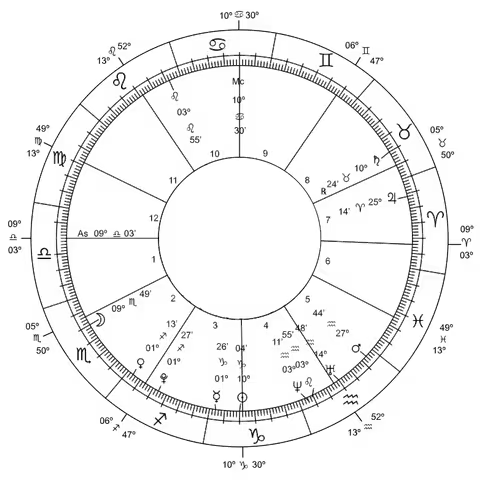
In Western astrology, 10 celestial bodies form the foundation of chart interpretation. From the luminaries (Sun and Moon) that define your core identity and emotional nature, to the outer planets that shape generational themes and spiritual evolution, each planet carries distinct archetypal energies that influence every dimension of human experience.
Personal Planets
Personal planets move quickly through the zodiac and represent your core personality traits, emotional nature, communication style, relationship approach, and drive. Because they change signs frequently, they create the most individual differences between people born even days apart.
Sun
Rules Leo
What does the Sun mean in astrology? It is your core self. The Sun in a birth chart points to your conscious ego, your willpower, and the identity you build over a lifetime. In Western astrology, your Sun sign is the single strongest indicator of character. It shows what motivates you, how you express yourself, and the kind of life you naturally gravitate toward. Think of it as the central engine of the chart. Every other planet orbits around what the Sun sets in motion. Where the Sun falls by sign and house, you'll find your greatest confidence, your creative spark, and the area of life where you most want to be seen.
Moon
Rules Cancer
The Moon in astrology is your emotional core. If the Sun is who you are, the Moon is how you feel and what you need to feel safe. It points to your subconscious reactions, your habits, and the emotional patterns laid down in early childhood, especially through the relationship with a mother or primary caregiver. Moon sign meaning goes beyond mood. It shapes your instincts, your memory, and your inner world. The Moon's sign and house placement tell you how someone processes feelings, what brings them comfort, and the private emotional landscape that others rarely get to see.
Mercury
Rules Gemini & Virgo
Mercury in astrology is the planet of the mind. It shapes how you think, how you talk, how you process information, and how you connect ideas. Mercury is the bridge between your inner world and the outer one, turning thoughts into words and perceptions into understanding. It rules every form of communication, from a text message to a legal contract, along with commerce, technology, and transportation. What does Mercury represent in your birth chart? Look at its sign and house to learn your intellectual style, how you prefer to learn, and what your communication habits look like.
Venus
Rules Taurus & Libra
Venus in astrology is the planet of love, beauty, pleasure, and values. It determines what you find attractive, how you show affection, what you spend money on, and how you behave in close relationships. Venus goes beyond romance. It also covers aesthetics, art, social harmony, and the principle of attraction itself. Venus sign meaning in your birth chart tells you your love language, your taste, your relationship style, and the specific things that give you the most satisfaction. If you want to understand someone's approach to love and money, look at their Venus.
Mars
Rules Aries
Mars in astrology is the planet of action, desire, and physical energy. It drives how you assert yourself, compete, pursue goals, and express anger. Mars is the force that turns intention into movement. Without it, every other planet's influence stays theoretical. What does Mars represent in your birth chart? Its sign placement shows your assertiveness style: whether you charge ahead or take a calculated approach. Its house placement shows where you pour your energy. Mars also rules sexual drive and the way you handle conflict, making it one of the most immediately felt planets in any chart.
Social Planets
Social planets bridge the personal and collective realms. Jupiter and Saturn move slowly enough to be shared by age groups, yet their house placements and aspects remain deeply personal. They govern growth, expansion, discipline, and the structures you build in society.
Jupiter
Rules Sagittarius
Jupiter in astrology is the planet of expansion, abundance, and good fortune. Traditionally called the Great Benefic, Jupiter is where you find growth, opportunity, and the desire to reach beyond your current limits. It connects to higher education, philosophy, religion, long-distance travel, and the search for meaning. What does Jupiter represent in a birth chart? Its sign shows your style of growth and your philosophical outlook. Its house shows the area of life where you get the most luck, the biggest opportunities, and the strongest pull toward learning and exploration. Jupiter spends about a year in each sign, so it also marks generational attitudes toward belief and expansion.
Saturn
Rules Capricorn
Saturn in astrology is the planet of structure, discipline, and hard-won achievement. Often called the Great Teacher or Lord of Karma, Saturn is where you face your toughest lessons, your biggest fears, and the work that nobody else can do for you. It rules boundaries, rules, time, and consequences. Saturn's effects in a horoscope can feel heavy. Delays, restrictions, and setbacks are part of the package. But Saturn also builds the foundation for everything that lasts. Its sign shows the style of discipline you need to develop. Its house shows the area of life where you must put in the most effort and where your most enduring accomplishments will eventually stand. Saturn takes about 29.5 years to complete a full cycle, which is why the Saturn return (around ages 29 and 58) marks such a turning point.
Transpersonal Planets
Transpersonal (outer) planets move so slowly that entire generations share the same sign placement. Their influence is felt most powerfully through house placement and aspects to personal planets. They represent forces of collective transformation, spiritual awakening, and evolutionary change.
Uranus
Rules Aquarius
Uranus in astrology is the planet of sudden change, innovation, and rebellion. Discovered in 1781 during the era of the American and French Revolutions, its timing matches its meaning: breaking old structures and opening space for something radically new. Uranus rules technology, science, humanitarian ideals, and the future. Because it takes 84 years to orbit the Sun, its sign placement describes the revolutionary themes of an entire generation. What does Uranus represent in your birth chart? Its house placement shows where you are most unconventional, where you resist conformity, and where sudden breakthroughs (or disruptions) are likeliest to happen. Uranus transits tend to arrive fast and change things permanently.
Neptune
Rules Pisces
Neptune in astrology is the planet of dreams, illusions, and spirituality. Discovered in 1846 during the rise of Romanticism, photography, and anaesthesia, its symbolism fits: dissolving the line between what is real and what is imagined. Neptune rules imagination, compassion, idealism, and the collective unconscious. It also rules escapism, addiction, and deception. Because it takes nearly 165 years to complete one orbit, Neptune shapes the spiritual and artistic themes of entire generations. What does Neptune represent in your birth chart? Its house placement shows where you are most idealistic and inspired, but also where you are most vulnerable to illusion and self-deception. Neptune asks you to dream, but it also asks you to stay honest about what you are seeing.
Pluto
Rules Scorpio
Pluto in astrology is the planet of transformation, power, and complete psychological overhaul. Discovered in 1930 alongside the rise of nuclear physics and psychoanalysis, Pluto is the force that destroys what is no longer working so something new can take its place. Though reclassified astronomically as a dwarf planet, Pluto keeps its full weight in astrological practice. It connects to the deepest psychological drives, the shadow self, and the processes of death and rebirth that happen within a single lifetime. Because Pluto takes 248 years to orbit the Sun, its sign placement marks the power dynamics and transformation themes of entire civilisations. What does Pluto represent in your birth chart? Its house shows where you go through the most intense changes, the hardest power struggles, and the kind of breakdown that eventually leads to real renewal.
Western vs. Vedic Planetary Systems
Western astrology uses 10 planets: the two luminaries (Sun and Moon), five classical planets (Mercury, Venus, Mars, Jupiter, Saturn), and three modern planets (Uranus, Neptune, Pluto) discovered through the telescope. Vedic astrology, by contrast, works with the 9 Navagrahas, which include the lunar nodes (Rahu and Ketu) but exclude the outer planets.
Another key difference is dignity. Western astrology recognises exaltation, detriment, and fall for each planet, while Vedic astrology adds concepts like Moolatrikona and directional strength (Dig Bala). Both systems agree that a planet's condition profoundly affects its ability to deliver results in the chart.
Explore More Western Astrology
Planets express themselves through the 12 zodiac signs and the 12 houses. The relationships between planets are described by aspects, which reveal how different parts of your personality interact.
Discover Your Planetary Placements
Curious which planets are strong or challenged in your birth chart? Our AI astrologer can analyse your planetary placements and reveal their impact on your life.
Analyse Your Birth Chart